Can you name a small evergreen native tree that has good wind, salt, drought and alkalinity tolerance, attractive white fragrant flowers, edible reddish orange fruit, interesting exfoliating reddish-brown bark and a reputation for curing diarrhea? Well, it’s Myrcianthes fragrans, Simpson’s stopper or Twinberry.

It’s modestly threatened in the wild in Florida. While rarely encountered, it can be found here and there in the landscape trade in that state, rarely elsewhere. Agristarts sometimes offers tc plants. We’ve had this plant for a good number of years at SFA Gardens, Nacogdoches, TX, and it’s performed well, but we like it even better in our Moody Gardens research plots on Galveston Island, TX, – see image below – where it’s held up to epic wind and salt challenges. Plants are rather dense in full sun, less so in part shade.
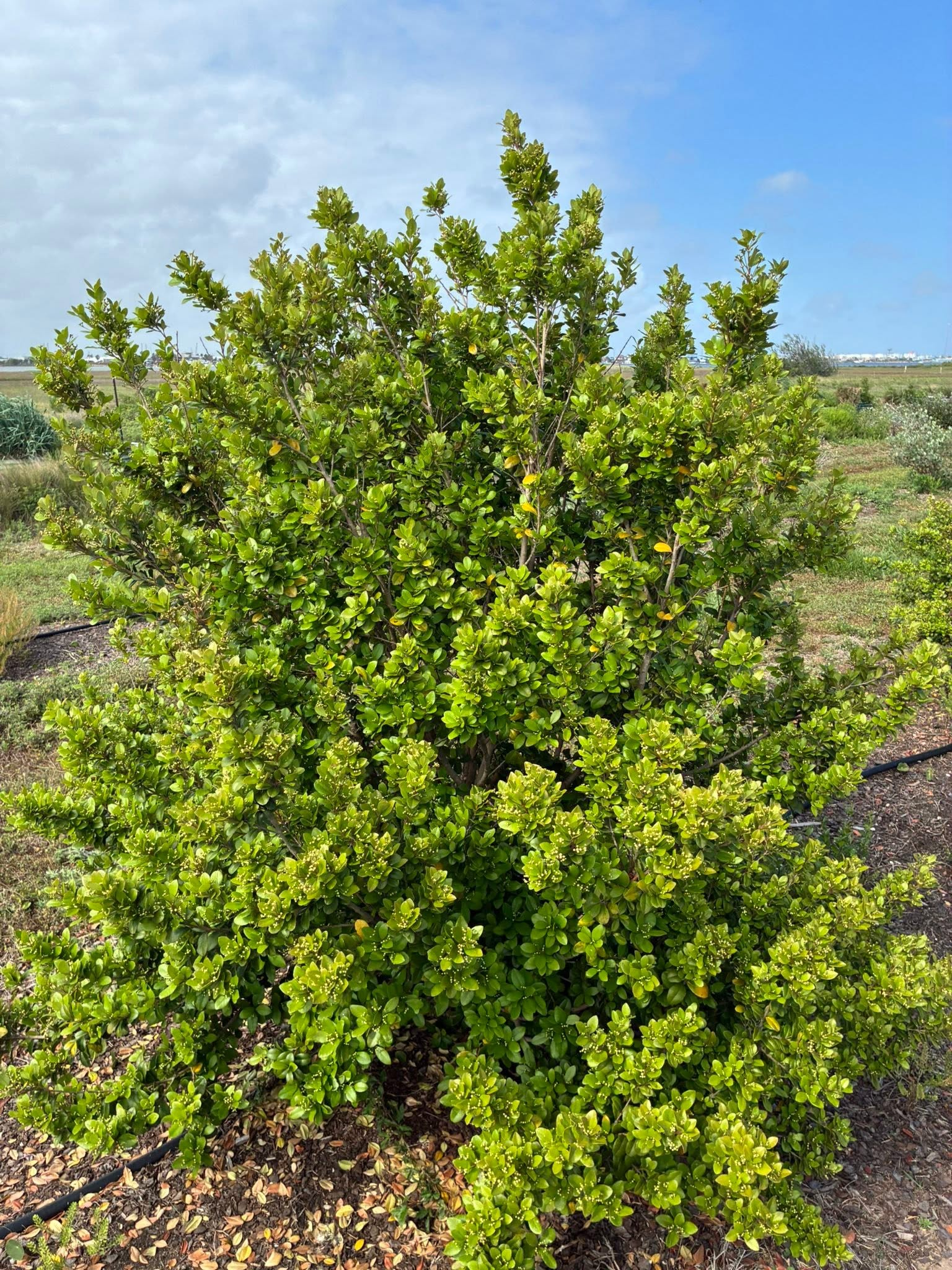
Of course, there are some negatives. First is cold hardiness. While it’s often considered a 9A plant, we beg to differ. It’s been quite tolerant of freezing temperatures into the teens at SFA Gardens and returned well from near the ground after the February 16, 2021 winter storm Uri event when temperatures fell to -4oF, a record all time low in our Pineywoods Texas home. A second negative is that we have seen it send up some suckers in a good spot.
In the wild in Florida, it occurs naturally in coastal strands and hammocks. There it is reported to have year-round blooms that attract a variety of butterflies and bees. The fruit is appreciated by many bird species and while the sweet flesh is edible to humans, eating the bitter seeds is not recommended. The flowers remind me a bit of widow’s frill, Silene stellata, and are dramatic in full bloom. Each fragrant flower has four white petals and many long white stamens. Leaves are bright green, ovate to elliptic and leathery and when crushed, they emit a citrusy aroma. Fruits start off as greenish ovoid berries that transition into bright reddish-orange as they mature. They are typically born in pairs (hence the name “twinberry”). There are a number of varieties in the trade but they are almost impossible to find outside of a few nurseries in Florida. In general, seedling grown plants in Florida top out at around 20’. Propagation by seed is easy. We typically stratify for two or three weeks and sow. Emergence is quick and the seedlings are tough. We’ve had good success with cutting propagation almost any time of the year.

Plants grown in sun are denser and flower more. The champion Simpson’s stopper comes in at 38 feet tall and it’s living in Okeechobee County in Florida. We have a form from Mexico via Adam Black and it appears to differ little from the Florida genotypes. We have a ‘Compacta’ and a ‘Nana’ which are smaller in stature and a bit slower to finish in the container. We have a clone called ‘Geode’ that we like and it propagates easy. We have a variegated form, ‘Stoppermorph’ but it doesn’t bloom at all for us and it seems a little harder to root. It also doesn’t seem to grow old gracefully although it can be cut back and rejuvenated. It is occasionally sold by Agristarts as a tissue culture plant.

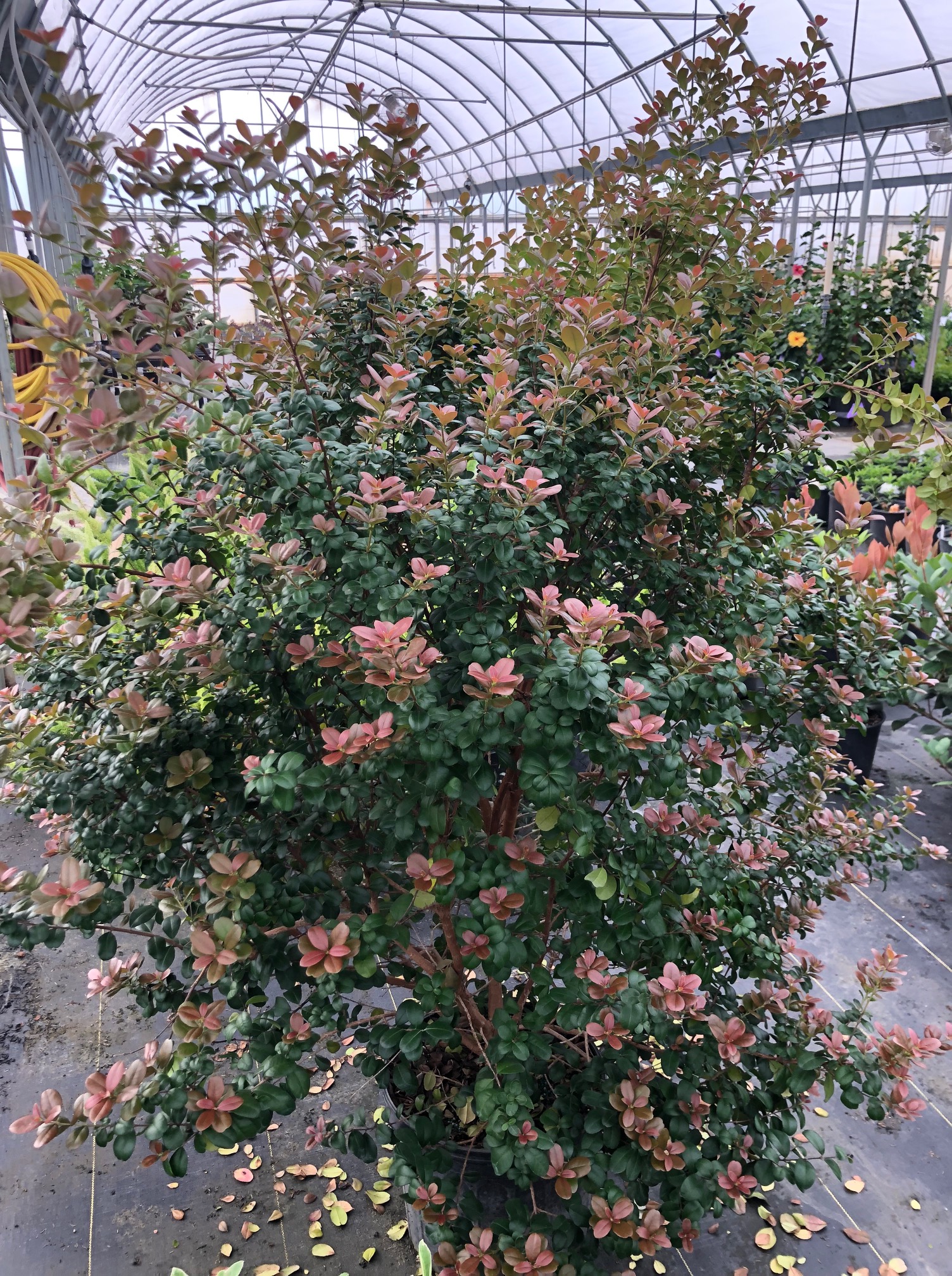
Finally, Jim Berry of JBerry Nursery picked out several seedlings from our nursery and has one that sports showy burgundy new growth. I like it. We twisted Jim’s arm and we have it back in the garden and have propagated it for further trials. Here’s a pic taken a few years ago in his research pen. Brook McCown, JBerry Nursery R and D, reports its been a trouble tree plant for years.
With so many positives, we think this plant is a Gulf South native that certainly deserves more attention. I speak far and wide and have long been asking folks have they ever heard of the plant? Some of the bonafide geeks know it, but most don’t. We have been looking at this plant in the nursery, in the ground here and at other gardens and it seems like a winner to us. Our next push is 1) to put in a large planting of named clones and seedlings in our Moody Gardens research plot, and 2) plant more seedlings here to find superior cold hardiness for the future, and 3) do some hedging, clipping and topiary attempts to see how the plant responds. I’m convinced there’s good opportunity for selecting improved forms and we think this might be a perfect patio container plant in regions that get freezing temperatures into the single digits. For those near the coast, this plant needs to be in your your shopping cart.


Happy to see you back blogging. I enjoy learning about new plants. I am right in between your location and Galveston. Maybe it would be a sweet spot for the Twinberry.
LikeLike
Thanks – lots of confusing changes to wordpress and I’m a fossil somewhat resistant to change
LikeLiked by 1 person
yes it would . . . I’ve edited the wordpress article on Myrcianthes . . . we do have a number of clones in the SFA Gardens plant sale this fall.
LikeLiked by 1 person
Yes, good to see you back. Coincidence … I was reading our old pal, Loren Eiseley’s The Immense Journey last night. He wrote about the explosion of flowers somewhere around the last part of the Age of Reptiles. Anyway, it was news to me that humans never would have made it without flowers. No wonder we used to wear them in our hair. So, this is a beautiful post, fitting since it is about a flower, one I knew nothing about. Good luck. Duke
LikeLike
Dave,
sounds like it’s be happy here in Hancock cty miss. I’m kidding eyesight and hard to read past first few paragraphs. stop in at diamondhead any time you paying thru on the i-10.
best to you and the wife.
sally LeBourgeois
LikeLike
Thank you, will do.
LikeLike
what is the seed size of the red stopper berry pls
LikeLike
Very small – clean fruit off and stratify for three to four weeks
LikeLike
very small but germinate readily and grow off nicely
LikeLike
what is the size of red stopper berry seed ,thank you
LikeLike
very small but germinates readily
LikeLike
It’s small but germinates without stratification if cleaned. We generally give it a few weeks cold/moist and it comes up readily.
LikeLike
Pingback: 10 Native Plants Birds Depend On In Florida This February
Pingback: These 9 Native Shrubs Thrive In Florida Front Yards When Planted In March
Pingback: SFA GARDENS PLANTS OF PROMISE – AN INDEX | Dave Creech